
Unlocking the power of ASR: From transcription hassles to business advantages
Automatic speech recognition has evolved from a costly manual burden into a genuine business advantage. Here’s how AI is driving that shift.
In the ever-evolving landscape of innovation in Artificial Intelligence (AI), speech-to-text technology, or Automatic Speech Recognition (ASR), is a shining example of progress.
Automatic speech recognition revolutionized the way we convert spoken language into written text, rendering the tedious and time-consuming task of transcribing audio to text, a task of the past. In this blog post, I will explore the journey of speech recognition technology, its current state, and how it can benefit businesses across various industries.
The rise of automatic speech recognition: A historical overview
Before diving into the benefits, let’s first understand what speech-to-text entails. With the capability to convert speech to text, ASR automatically converts spoken language into written text. It has come a long way, particularly when we consider its historical context.
Prior to the rise of ASR, transcribing audio to text was a manual process, a painstaking task that consumed both time and resources. The human element in transcription services introduced inaccuracies, with mistakes, and inaccurate transcription for things like industry-specific acronyms or heavy accents, making it a less-than-ideal solution for businesses. However, with advancements in ASR, we now have the power to transform spoken words into text swiftly and with remarkable accuracy.
Speeding up processes: The benefit of faster data entry with ASR
Today, speech-to-text technology has reached unprecedented levels of accuracy and efficiency. Businesses can harness the power of automatic speech recognition for a wide range of applications, unlocking a multitude of benefits along the way. A few include:
Productivity: ASR significantly enhances productivity by automating transcription tasks, freeing up valuable time for employees to focus on more strategic activities.
Faster data entry: With ASR, data entry is simple and effective. Simply speak and the speech recognition technology does the heavy lifting to convert voice to text, reducing the time and effort required to input data.
Streamlined documentation: ASR simplifies the process of creating and updating documents, making it easier to maintain accurate records.
Improved accessibility: ASR promotes inclusivity for diverse and remote teams, ensuring that everyone can participate and collaborate not only effectively, but with accurate information.
Reducing transcription costs: By eliminating the need for manual transcription services, businesses can significantly cut down on transcription-related expenses.
Minimizing errors: ASR boasts remarkable accuracy, minimizing the risk of errors in transcriptions.
Exploring where ASR can benefit various industries is the fun part. We can see this speech recognition technology come to life in incredibly innovative and fundamental ways:
Earnings call transcripts: ASR can be fine-tuned to accurately transcribe earnings calls, delivering accurate information to investors more quickly, accurately, and in real-time.
Customer support: ASR aids in query resolution, analyzes customer feedback, and supports market research, improving overall customer satisfaction.
Explore Kensho Scribe: Your path to transcription efficiency
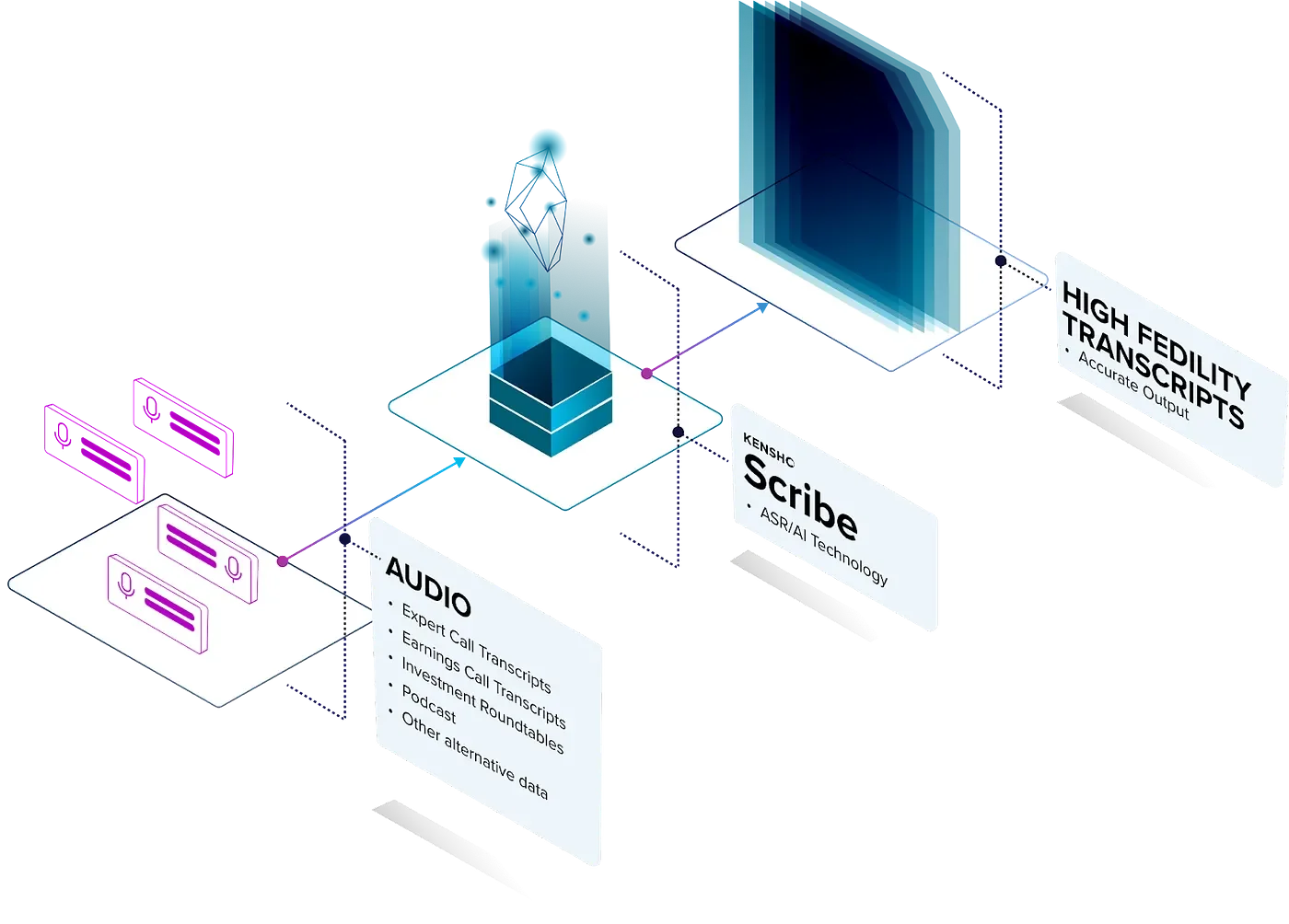
One notable example of Automatic Speech Recognition (ASR) technology in action is Kensho Scribe, a machine learning-based service that transcribes business and financial audio with unparalleled accuracy, speed and security. At Kensho, we utilize AI-assisted transcription that combines the expertise of humans trained in business and finance language with AI models specialized in the same domain. This approach ensures that we can provide 99.9% accurate earnings transcripts in a fraction of the time it would take through manual transcription. Kensho regularly retrains the model on earnings transcripts to recognize and accurately transcribe trending terms such as “COVID” and “GenAI.”
While voice recognition technology offers numerous advantages, it’s essential to address potential challenges, including biases in model training around accents and dialects as well as privacy and compliance concerns. Implementing appropriate safeguards and continuously improving algorithms can help mitigate these challenges.
Press enter or click to view image in full size
Speech to text technology has transformed the way businesses handle spoken language, offering efficiency, accuracy, and a host of other benefits. From earnings call transcripts to customer support, ASR technology is a game-changer. If you’re looking to enhance your business’s transcription capabilities and unlock new possibilities, consider harnessing the power of ASR technology.
Explore Kensho Scribe and take the first step towards a more productive and accurate future in transcription. Start a free trial here!
General FAQ
1. How does Automatic Speech Recognition (ASR) contribute to business productivity?
Automatic Speech Recognition (ASR) enhances productivity by automating transcription tasks, freeing up time for employees to focus on more strategic activities. It streamlines data entry and documentation processes, reducing the time and effort required for these tasks.
2. Can ASR be applied to specific business functions, such as earnings calls?
Investor targeting solutions assist tasks such as maintaining a suitable shareholder base, reducing share register risks, and optimizing management time for vital investor meetings. They also support market monitoring, peer and company performance analysis, shareholder acquisition and retention, stock valuation management, and volatility reduction.
3. How does ASR technology minimize errors in transcriptions?
ASR boasts remarkable accuracy, minimizing the risk of errors in transcriptions. By eliminating the human element in the transcription process, it ensures a higher level of precision..